
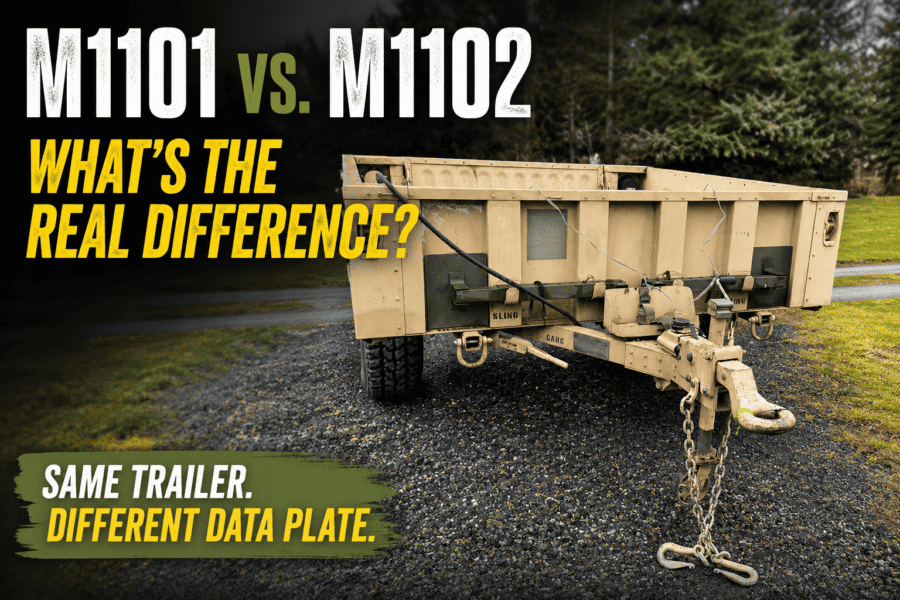
M1101 vs. M1102 Military Trailers: The Difference Is Smaller Than You Think
Spend enough time browsing military surplus auctions or Facebook Marketplace and you’ll inevitably see people debating whether an M1101 or an M1102 is the “better” trailer. Some sellers even advertise one as being stronger or built heavier than the other.
Here’s the surprise:
The M1101 and M1102 are physically the exact same trailer.
The only real difference is the identification plate (data placard) attached to the trailer. That placard specifies the allowable Gross Vehicle Weight (GVW) based on the military vehicle that was expected to tow it. Here’s what makes them different, a metal data plate that has different ratings based on the TOW VEHICLE, NOT THE ACTUAL TRAILER ITSELF. And yes, I need to figure out how to clean mine before it goes back on the trailer – pressure washing did nothing, apparently I need to buff it.
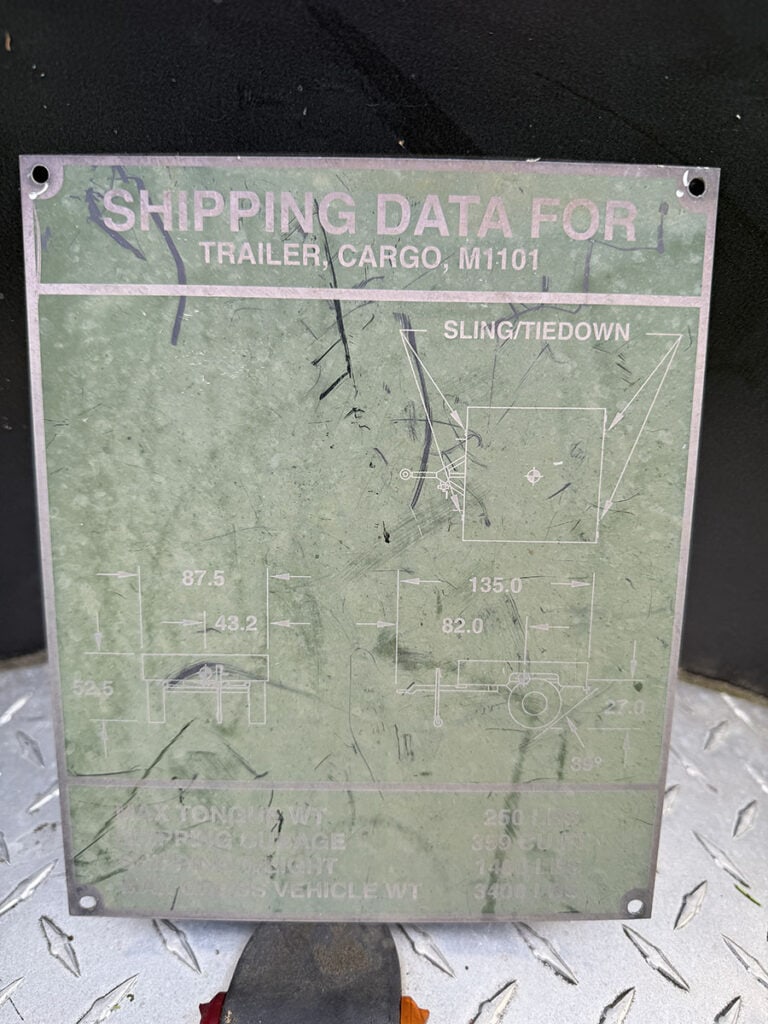
So if you’re converting one into an overland trailer, utility trailer, or expedition camper, you’re starting with the exact same platform regardless of whether the data plate says M1101 or M1102.
Why Two Different Model Numbers?
The U.S. Army needed a trailer that could be towed behind several versions of the HMMWV (Humvee).
Not every Humvee had the same towing capacity.
Rather than designing two separate trailers, the Army simply assigned two different model designations that reflected the maximum allowable loaded weight for the intended tow vehicle.
M1101
- Intended for lighter HMMWV variants such as the M998 and M1038
- Maximum GVW: 3,400 pounds
- Payload approximately 1,940 pounds
M1102
- Intended for heavier-duty HMMWV variants including the M1097 and armored M1114
- Maximum GVW: 4,200 pounds
- Payload approximately 2,740 pounds
The trailer itself never changes—the identification plate simply limits how heavily it may be loaded behind specific military vehicles.
Same Chassis. Same Suspension. Same Components.
Whether your trailer wears an M1101 or M1102 data plate, you’ll find the same major components:
- Aluminum cargo tub
- Fully boxed steel frame
- Independent trailing-arm suspension
- Hydraulic surge brakes
- Parking brake
- Lunette ring pintle hitch
- 37-inch military tires
- Run-flat inserts
- 24-volt military lighting
- Heavy-duty landing leg
This is why nearly every modification—from 12-volt lighting conversions to aftermarket couplers and suspension upgrades—fits both trailers equally well.
If you’re shopping surplus auctions, condition is far more important than whether the data plate says M1101 or M1102.
So Why Does the Payload Rating Change?
The limiting factor wasn’t the trailer.
It was the Humvee.
Military planners needed to ensure that lighter HMMWV variants weren’t overloaded while towing fully equipped cargo trailers.
Instead of manufacturing two different trailers, they simply issued different identification plates showing different allowable Gross Vehicle Weights.
This simplified logistics, spare parts, maintenance, and production while ensuring military operators stayed within safe towing limits.
Who Built the M1101 and M1102?
Another common misconception is that one manufacturer built “better” trailers than another.
In reality, several defense contractors produced these trailers during Army procurement contracts.
Manufacturers you’ll commonly encounter include:
- Silver Eagle Manufacturing
- Raytheon (through its acquisition of Electrospace Systems/E-Systems)
- BAE Systems
- Schutt Industries
One interesting piece of history is that the original production contract was awarded to Electrospace Systems in 1993. The company subcontracted Silver Eagle Manufacturing in Oregon to actually build the trailers. After Raytheon acquired Electrospace in 1996, many trailers carried Raytheon identification while still being produced through the same manufacturing relationship. Later production contracts also involved other defense manufacturers including BAE Systems and Schutt Industries.
Is One Manufacturer Better?
Among surplus enthusiasts you’ll often hear claims that certain manufacturers built stronger trailers or that Silver Eagle tubs are somehow different.
In practical use, there is little evidence of meaningful differences in durability or capability between manufacturers.
All trailers were built to the same military specifications and parts interchange freely across production years.
When shopping for one, pay attention to:
- Overall condition
- Rust or corrosion (the tub is aluminum, however the frame and other components are steel and may corrode)
- Surge brake condition
- Landing leg upgrades
- Tire condition
- Whether required military modification work orders (MWOs) have been completed
These factors will matter far more than the name stamped on the data plate.
Which One Should You Buy?
The answer is simple:
Buy whichever trailer is in the best condition.
Since both models share the same frame, suspension, body, brakes, wheels, and nearly every serviceable component, there’s no practical advantage to choosing one designation over the other for civilian use. In fact, it might be a matter of what modifications have already done and how much work you’re wanting to put into your trailer.
Whether your goal is an overland camper, off-road utility trailer, motorcycle hauler, or expedition build, an M1101 and M1102 offer the exact same rugged military foundation.
Don’t overpay simply because a seller advertises one model as being “heavier duty.” In almost every case, you’re looking at the same trailer with a different identification plate.
Final Thoughts
The M1101 versus M1102 debate has confused military trailer buyers for years, but the answer is refreshingly simple.
They’re the same trailer.
The different model numbers exist solely to match the towing capacity of the military vehicle assigned to pull them—not because the trailers themselves are built differently.
For civilian owners, that means you can confidently shop for the cleanest, best-maintained example regardless of what the data plate says.
That’s one less mystery standing between you and one of the toughest surplus trailers ever built.
More of Our M1101 Content
ChatGPT Designed, 3d Printed M1101 Replacement Marker Light Housings