
If you’re considering buying an M1101 military trailer or already own one, one of the first questions you’ll have is:
“What are the specifications?”
Unfortunately, there are dozens of websites repeating incomplete or even incorrect information. After researching military documentation and spending time working on my own M1101, I wanted to put together a single reference that covers nearly everything someone would want to know.
Whether you’re building an overland trailer, converting one for camping, or simply restoring one to military condition, these are the specifications you’ll find yourself referencing over and over.
M1101 Specifications at a Glance
| Specification | Value |
|---|---|
| Empty Weight (Curb Weight) | 1,460 lbs (662 kg) |
| Maximum GVWR | 3,400 lbs |
| Maximum Payload | 1,940 lbs |
| Overall Length | 132 in (11 ft) |
| Overall Width | 85.6 in |
| Overall Height | 52.5 in |
| Overall Height with Soft Top | 99.5 in |
| Track Width | 72.5 in |
| Deck Height | 34.5 in |
| Ground Clearance | 16 in |
| Suspension | Torsion axle |
| Spring Type | Progressive torselastic rubber |
| Brakes | Hydraulic surge brakes |
| Parking Brake | Mechanical |
| Electrical System | 24-volt military |
| Tires | 37×12.50R16.5 Goodyear MT |
| Wheels | 16.5-inch HMMWV military wheels |
| Bolt Pattern | 8×6.5 (8×165.1 mm) |
| Construction | Aluminum tub with steel frame components |
These figures are consistent with the military technical data for the M1101 cargo trailer.
Overall Dimensions
One of the biggest surprises for many new owners is how large the M1101 actually is.
It was designed to track directly behind a HMMWV, making it significantly wider than many civilian off-road trailers.
Exterior Dimensions
- Overall Length: 132 inches (11 feet)
- Overall Width: 85.6 inches
- Overall Height: 52.5 inches
- Width Between Tire Centers: 72.5 inches
- Ground Clearance: 16 inches
Because of its width, the trailer is extremely stable at highway speeds and on uneven terrain.
Interior Cargo Bed Dimensions
While military manuals emphasize overall dimensions, owners are often more interested in usable cargo space.
Typical interior measurements are approximately:
- Length: 86 inches
- Width between wheel wells: 56 inches
- Width at the top of the tub: approximately 74 inches
- Bed depth: approximately 16–18 inches
These dimensions make the trailer capable of hauling:
- Full-size ATVs
- UTVs (with the tailgate down on some models)
- Sheet goods
- Camping gear
- Firewood
- Construction materials
- Motorcycle hauling with ramps
Weight Ratings
One of the most misunderstood aspects of these trailers is the difference between curb weight, payload, and gross vehicle weight.
Empty Weight
Approximately:
1,460 pounds
This includes:
- Run-flat equipped military wheels
- Surge brake system
- Parking brakes
- Heavy-duty suspension
- Lunette ring
The wheels alone are extremely heavy due to the steel run-flat inserts.
Maximum Payload
The M1101 is rated for:
1,940 pounds
This produces a maximum gross vehicle weight of:
3,400 pounds
The heavier-rated M1102 uses the exact same trailer but carries a different identification plate allowing a higher GVWR when paired with heavier-duty HMMWV variants.
I cover this in much more detail in my article explaining What’s the Real Difference Between the M1101 and M1102?
Suspension
One reason these trailers have become so popular for overlanding is their extreme ground clearance thanks to the suspension design.
Unlike most trailers that use leaf springs, the M1101 uses a torsion bar suspension.
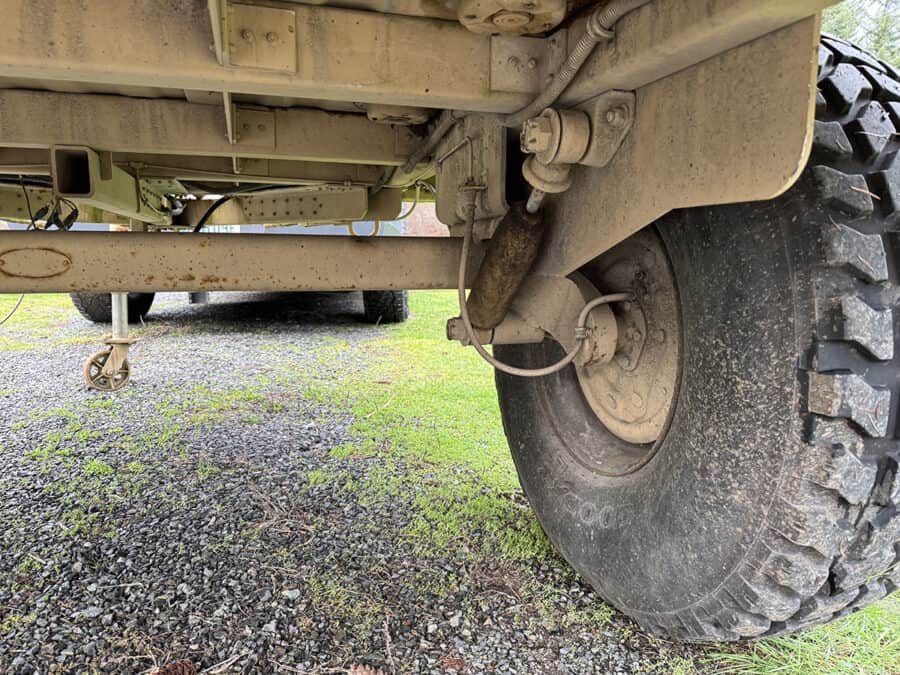
Benefits include:
- Excellent ground clearance
- High articulation
- Fewer moving parts
- No leaf spring hangers to catch on rocks
- Smooth towing over rough terrain
Even after decades of military service, many original suspensions remain in excellent condition.
Braking System
The factory braking system includes:
- Hydraulic surge brakes
- Mechanical parking brake
- Automatic breakaway braking
Unlike electric trailer brakes, the military designed the trailer to function without a brake controller.
Many owners keep the surge brakes because they’re simple and highly reliable.
Others convert to electric brakes during civilian restorations.
Tires and Wheels
The M1101 uses the same wheels found on military HMMWVs.
Factory equipment includes:
- 37×12.50R16.5 Goodyear MT tires
- Two-piece steel military wheels
- Internal steel run-flat inserts
One complete wheel and tire assembly is surprisingly heavy due to the run-flat system.
Many civilian owners eventually replace the original wheels with aluminum wheels matching their tow vehicle to reduce weight, improve tire availability, and lower the overall ride height of the trailer. Drop down to 33″ tires and you’ve lowered the trailer 2″ closer to the ground.
Construction
Unlike many military trailers built from steel, the M1101 uses a unitized aluminum cargo tub.
Benefits include:
- Excellent corrosion resistance
- Lower weight
- High structural strength
- Long service life
Critical suspension and tongue components remain steel for durability.
This combination makes the trailer incredibly rugged while resisting rust far better than older military trailers.
Electrical System
Factory configuration includes:
- 24-volt electrical system
- NATO military connector
- Blackout convoy lights
- Military marker lights
Most civilian owners eventually convert the trailer to:
- 12-volt wiring
- Standard 7-way RV connector or 4-pin connectors
- LED lighting
This allows the trailer to plug directly into most pickups and SUVs.
Towing Characteristics
One reason the M1101 has become so desirable is how well it tows.
The wide stance, independent suspension, and low center of gravity help it remain remarkably stable on pavement and rough forest roads.
Owners often comment that once properly loaded, it’s easy to forget the trailer is behind the tow vehicle.
Common Modifications
Popular upgrades include:
- 12V wiring conversion
- LED lighting
- Matching wheels and tires
- Adjustable hitch channels
- Lock-N-Roll articulating hitch
- RTT (roof-top tent)
- Bed racks
- On-board water systems
- Solar power
- Drawer systems
- Tongue boxes
- Electric brake conversion
- Powder coating or bed liner
The M1101 provides an excellent platform because the military engineering is already done—you simply customize it to your needs.
Frequently Asked Questions
Are the M1101 and M1102 physically different?
No.
They are built identically. The only difference is the identification plate and the allowable gross vehicle weight based on the military towing vehicle.
Is the M1101 aluminum?
Yes.
The cargo tub is aluminum while the frame, suspension, and tongue components are steel.
Does the M1101 have independent suspension?
No.
The M1101/M1102 utilizes a torsion axle.
Does the M1101 use electric brakes?
No.
From the factory it uses hydraulic surge brakes.
Can an M1101 tow behind a pickup?
Absolutely.
After converting the wiring and installing an appropriate hitch, many owners tow them behind Jeeps, Tacomas, Rangers, F-150s, Silverados, Broncos, and SUVs. Check your tow vehicles specs on it’s tow rating and how much additional weight you might plan on hauling with your M1101.
Final Thoughts
The M1101 remains one of the most capable military trailers ever offered to the public. Its combination of aluminum construction, rugged suspension, impressive payload, and military engineering makes it an outstanding foundation for everything from overland builds to utility hauling.
While it weighs more than many civilian trailers, that extra weight comes from the very features that make it so durable—heavy-duty suspension, surge brakes, robust wheels, and a structure designed to withstand years of military service. With a few thoughtful upgrades like 12-volt lighting, matching wheels, or an adjustable hitch, the M1101 becomes an incredibly versatile trailer that’s just as comfortable on the highway as it is on remote forest roads.
If you’re planning a build, understanding these specifications is the first step toward choosing the right modifications and getting the most from one of the best surplus trailers ever produced.